- News & Insights
- 2022
- How can sustainable fiber-based pallet collars optimize one-way shipments in automotive supply chains?
- Sustainability
- LiB and E-mobility
- Insights
News & Insights
Fiber-based pallet collars
How can sustainable fiber-based pallet collars optimize one-way shipments in automotive supply chains?
Find out how fiber-based pallet collars are revolutionizing one-way shipments in the automotive supply chain, offering an eco-friendly alternative to traditional wooden collars. These innovative collars promise affordability, durability, and a significant reduction in CO2 emissions. Read on to discover how you too can drive your automotive business towards a greener future.
The benefits of reusable packaging
It is believed that the use of reusable packaging goes back as far as 1930 to Ford Motor Company. At first, the main goal was to eliminate massive amounts of waste, but over time, reusable packaging became a key logistical element to improve productivity and inventory control. For the past decades reusable packaging dominated the automotive industry thanks to high product protection, repeatable and standardized size for easier automation, and enhanced durability at a lower transportation cost than single-use packaging. Today reusable packaging materials are an industry standard and are predicted to grow up to 170 billion USD by 2030.
Wooden collars are one of the most popular materials among returnable packaging in the automotive industry, especially in the North of Europe. They are strong, durable, and reusable. However, they are simply not the most sustainable option for one-way shipments. To meet customers' and markets’ expectations, Nefab developed a fiber-based alternative to wooden collars that provides a more sustainable future for one-way supply chains. Keep reading to uncover the benefits of fiber-based materials for one-way shipments.
The challenge of a returnable system
According to Guardian Container Consulting’s research, OEMs commonly spend 10’s of millions of dollars annually to replace lost reusable packaging – much of which is avoidable. One way is to invest in a tracking system and monitoring devices to check the localization of the fleet in real-time. However, finding a lost or stolen container is only part of the solution because the OEMs still need to maintain, repair, and inspect it before it can be used again. With thousands of containers used in each fleet, for many companies, it’s too challenging to manage the returnable system.
Moreover, returnable packaging is not always the most sustainable or efficient choice for all supply chains. It is most effective when there is a limited number of distribution points, short transport distances, and an adequate number of cycles in the goods flow. Considering these factors, many automotive companies are choosing one-way flows. If opting for this route, it is essential to select packaging materials that optimize costs, reduce waste, and minimize CO2 emissions. This is where Nefab’s latest fiber-based pallet collars come into play.
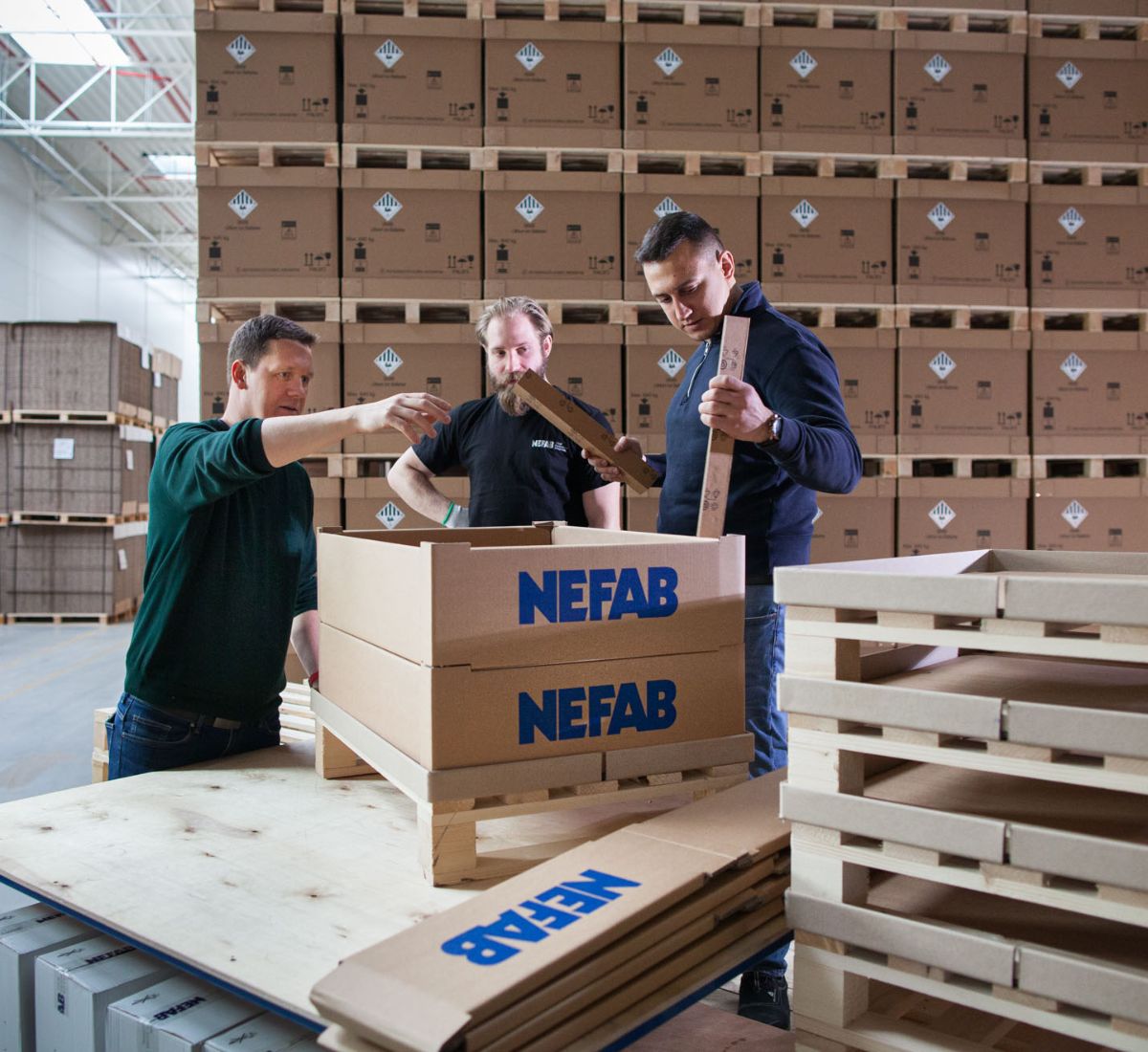 EdgePak Collar provides outstanding strength, faster assembly, and improved handling ergonomics
Sustainability in one-way automotive supply chains
Nefab's EdgePak Collar consists of up to three corrugated collars that are fixated and reinforced by strong, insertable corners made from strawboard. Straw fibers are short and very stiff compared to wood fibers used in paper products, which gives the material great strength. As a result, the new collars system can withstand up to 400 kg in dynamic stacking. Additionally, the compact, wet mechanical process makes straw pulp more resistant to moisture than standard paper, which improves packaging performance in humid conditions. Furthermore, its standardized structure is perfectly compatible with three standard pallet sizes (1200x800mm, 800x600mm, and 48"x40"), allowing for faster loading and unloading of the shipment.
Last but not least, fiber-based collars provide a quiet, safe, and ergonomic working environment while also simplifying shipment. In fact, they weigh 58% less than a wooden solution with a comparable structure—one EdgePak Collar, including three collars stacked on top of one a Euro pallet, weighs 35 kg compared to 58 kg of the wooden solution. As a result, the solution is easier and more ergonomic to handle for the staff, while the lower weight saves money and CO2 emissions in transport, especially if sent by air.
The unique combination of corrugated pallet collars and foldable corners made of strawboard provides outstanding strength, faster assembly, and improved shipping ergonomics.
Reducing CO2 emissions by 53%: A fiber-based future ahead
Based on a pilot case study with a Swedish bearings manufacturer, switching from wooden to fiber-based collars (1/2 EUR pallet size) in one-way flows helped the company save 53% CO2 emissions annually in this supply chain. This number is equivalent to 2,678 passenger vehicles driven for a full year and over 1.3 million kilograms of saved landfill waste. Naturally, the data can vary depending on each case, but the example provides a good overview of this solution’s potential to optimize one-way flows in the automotive industry.
It is important to underline, though, that fiber-based pallet collars are not aiming to replace wooden collars completely, but rather complement them. In fact, fiber-based collars enable companies to use sustainable solutions for both one-way shipments and returnable flows. Regardless of the chosen material, sustainable packaging leads to a more efficient supply chain. Reducing packaging materials is one of the representative efforts, which improves environmental performance and reduces operational costs for a better tomorrow.
We save resources in supply chains, for a better tomorrow.
Want to learn more?
Explore EdgePak Collar
GET IN TOUCH
Contact us to learn more about our sustainable solutions driving supply chains forward.
LEARN MORE
GreenCALC
Nefab’s own certified calculator measures and quantifies financial and environmental savings in our solutions
Sustainable Solutions
Engineered packaging for sustainable supply chains
Sustainable Materials
Fiber-based packaging and raw materials