For healthcare equipment, packaging is a part of product’s performance. These systems are often high-value, sensitive, and critical to patient care. If packaging fails, the device can arrive damaged, delayed, or unusable. In the worst cases, packaging issues can contribute to quality issues that lead to product complaints or recalls.
That risk is real. In 2025, the US recorded 699 medical device recalls1 . Interestingly though, the FDA also tracks “packaging” as a recognized recall root-cause category, which reinforces an important point: packaging problems are not rare cases. They are something the industry monitors closely.
So how do healthcare OEMs reduce risk, protect product integrity, and meet regulatory expectations at the same time? That’s where engineered packaging2 comes in.
Shipping Healthcare Equipment is Especially Challenging
Healthcare equipment is complex by design. Even a single system can include hundreds of parts and components, often sourced globally and assembled across multiple sites. Some sources report that a typical MRI system contains 252 parts sourced from 15 different countries3 .
This matters because one damaged component can create a domino effect. It’s not only the cost of replacement, but also the disruption that follows: halted installation, service issues, missed timelines, and potentially delayed care.
Engineered packaging helps prevent these problems by designing protection around the real transport conditions i.e. vibration, shock, compression, stacking, temperature shifts, and frequent handling.
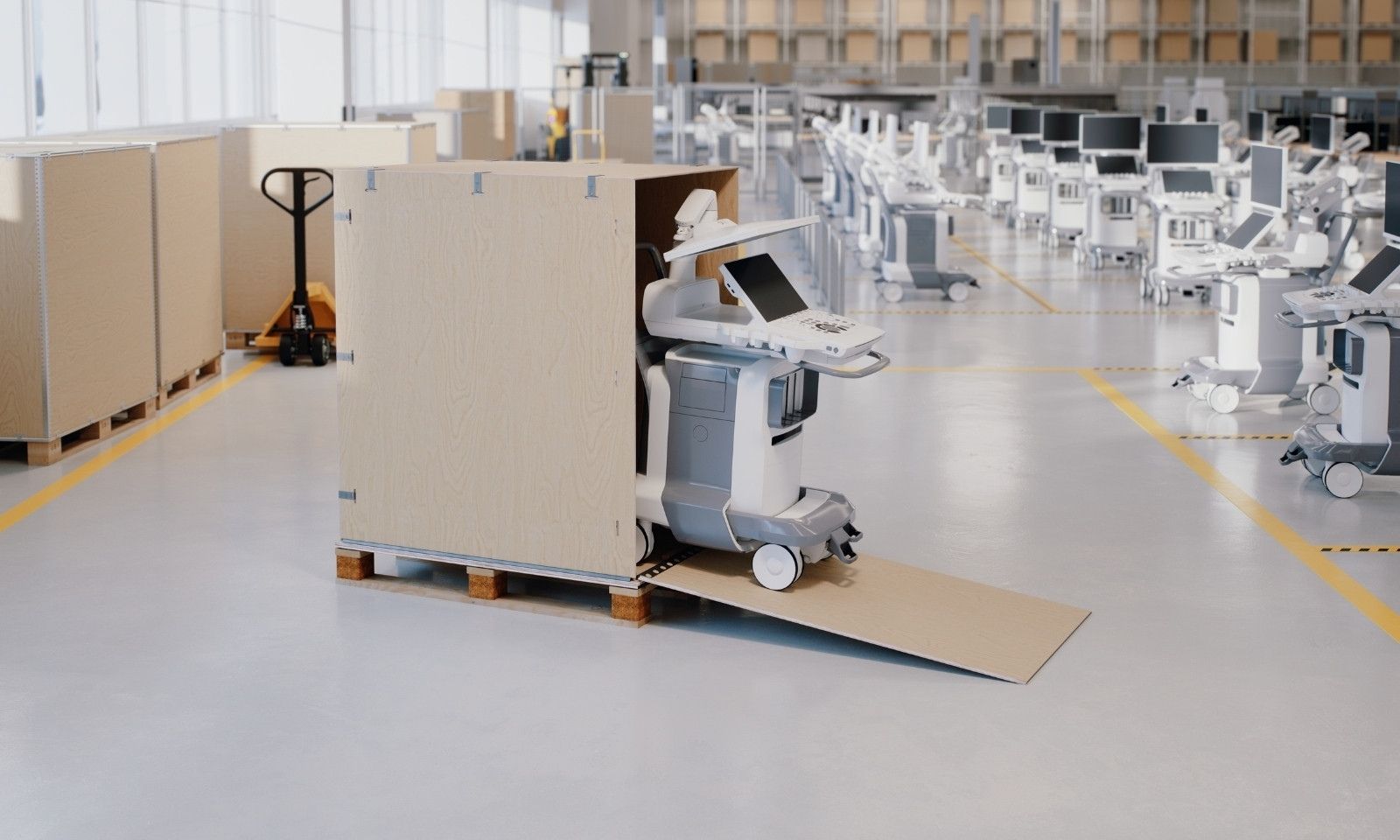
How Packaging Protects Healthcare Equipment in Transit Engineered packaging is built around the product, not around standard sizes or generic materials. The goal is to reduce movement, reduce stress on sensitive components, and maintain product integrity from the moment it leaves the factory until it reaches its destination.
Three key elements of engineered packaging that matter most for medical devices:
- Material selection
Different products have different vulnerabilities. Some are sensitive to impact. Others to vibration. Some are heavy and need structural strength. Others have delicate optics or electronics that require stability and cushioning.
Engineered packaging teams select both external materials and internal cushioning systems to match product-specific needs: strong enough to survive transport conditions, without being overbuilt or inefficient4 . - Design that stabilizes and protects
A well-designed package doesn’t just “pad” the product, it holds it securely in place. That means protecting internal components, preventing shifting, and reducing mechanical stress during handling and transit5 .
This is especially important for expensive systems where even minor damage can make the entire unit non-functional. - Testing that validates the protection
Once packaging is complete, the packaging prototype is tested to confirm it can withstand real transport and storage conditions6 .
ISTA procedures simulate real-world shipping conditions such as drops and vibration. This helps demonstrate that a package can survive practical handling and transportation stresses. When packaging is too large or heavy for standard lab testing, engineers can use Finite Element Analysis (FEA) to stimulate real-word stresses and strains virtually and validate the design before shipment7 .
How Packaging Supports Medical Device Compliance
Protection is only half the job. In healthcare, OEMs also need to prove packaging performance through documented processes, controlled design methods, and test evidence that holds up under scrutiny.
That’s why engineered packaging is often developed within a broader quality management framework. Nefab, for instance, operates under ISO 13485, which supports controlled packaging design processes, supplier oversight, validation practices, and traceable documentation throughout the packaging lifecycle8 .
Packaging performance must also be verified through reliable and repeatable testing. ISO 17025 certification9 confirms the technical competence of testing laboratories and strengthens confidence in test methods and results used to validate packaging designs.