• Sustainability
  • Corporate News

Nefab Hungary wins the Innovation and Technology prize

Nefab Hungary won the award of the Hungarian Ministry of Innovation and Technology at the Hungaropack Packaging Contest 2021.

We are happy to announce that Nefab Hungary won the award of the Hungarian Ministry of Innovation and Technology at the Hungaropack Packaging Contest 2021.

Redesigning a Heavy Transport Packaging

The challenge was to redesign one of our customer’s heavy and complicated transport packaging method while reducing its environmental impact and total costs. The Nefab team opted for replacing it with a customized environmental friendly solution.

Quantified Sustainability Improvement

Using GreenCALC, Nefab's proprietary environmental impact calculator, the team achieved remarkable results:

  • 113 metric tons of CO2 emissions saved, cutting emissions by 50% compared to the original design. These savings are equivalent to the annual CO2 emissions produced by 24 cars.
  • Waste generation significantly reduced.
  • A cost reduction of €100,000, representing a 49% savings compared to the original packaging design.
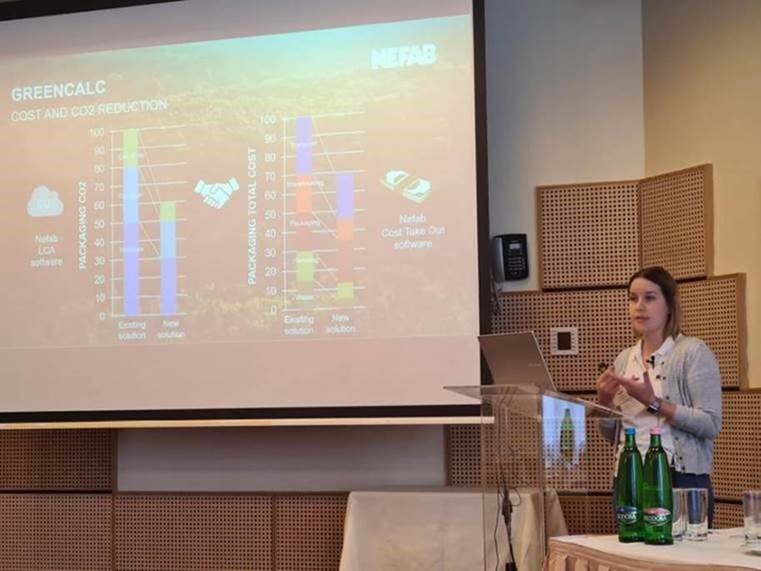
 

Learn more about Nefab’s GreenCALC and how we save resources in supply chains, for a better tomorrow!

Our latest news & insights
  • 2026.07.30 Corporate News

    Changes to the Nefab Board of Directors

    Nefab Group AB has, by resolution of the General Meeting on 1 July 2026, decided on changes to the Board of Directors (BoD).

  • 2026.07.14 Corporate News

    Why Sustainable Packaging Is About More Than Materials

    Sustainable packaging involves far more than material selection. In industrial packaging, engineering decisions around design, product protection, logistics, and lifecycle performance often have a greater impact on environmental footprint than the material itself.

  • 2026.06.29 Insights

    How Manufacturers Can Regionalize Operations Without Sacrificing Consistency

    As manufacturers regionalize operations to improve resilience and responsiveness, maintaining consistency across multiple locations is becoming increasingly challenging. Balancing global standards with local execution can help companies reduce complexity, maintain consistency, and improve supply chain performance.