Lithium battery technology dates to the 1970s, when early breakthroughs laid the foundation for rechargeable batteries1 . The first commercial lithium-ion battery (LiB) didn’t arrive until 1991, when Sony introduced it for portable electronics2 . Industrial-scale growth came much later, accelerating in the mid-to-late 2000s as electric vehicles (EVs) and energy storage began to take off. That’s also when LiB logistics started to scale a more industrial way.
“Back in the mid-2010's, the main packaging challenge was staying compliant with United Nations Dangerous Goods (UNDG) regulations and ensuring shipments could move safely through complex international routes,” said Amaury Fruchaud, Global LiB Segment Director at Nefab Group. “Packaging solutions were built to be robust, prioritizing safety and compliance over cost efficiency, automation readiness, or sustainability.”
What’s Driving Lithium-Ion Battery Packaging Decisions Today
If you are buying packaging for LiBs today, you are operating in a different world than even five or ten years ago.
Battery volumes are rising quickly, driven by exponential growth in EVs and energy storage3 . At the same time, production is becoming more automated, and sustainability requirements are becoming more stringent.
For procurement and supply chain teams, the focus shifted from basic protection to precision, durability, and lifecycle efficiency.
Several clear trends are shaping packaging decisions:
- Automation is becoming a baseline
More battery plants are moving toward automated handling4 , which means packaging must be consistent. If trays deform, differ from the defined dimensional tolerances, or don’t stack well, it can disrupt a line or slow down material flow. - Sustainability and circularity
Sustainability requirements are becoming more stringent across the globe. Packaging choices are increasingly being assessed for recyclability, reusability and overall environmental impact5 . - Rapid Volume Growth
Battery production often scales faster than anticipated. Packaging choices made early can either support that growth or force costly redesigns later.

Lithium-ion battery production becomes increasingly automated.
Early Solutions: Foam Trays
Initially, battery modules and cell shipments relied heavily on Expanded Polyethylene (EPE) foam trays. These trays were cheap to mold, light, and provided effective protection for sensitive battery components.
However, as battery production grew, the downside of foam became harder to ignore. Over time, many companies ran into problems:
- The trays lost their shape and compress
- They do not always hold up well and tend to degrade over multiple reuse cycles
- Large dimensional variation made automated handling more difficult
- Recycling proved challenging, inconsistent and was dependent on local waste management systems
What worked well at low volume often became a constraint at scale.
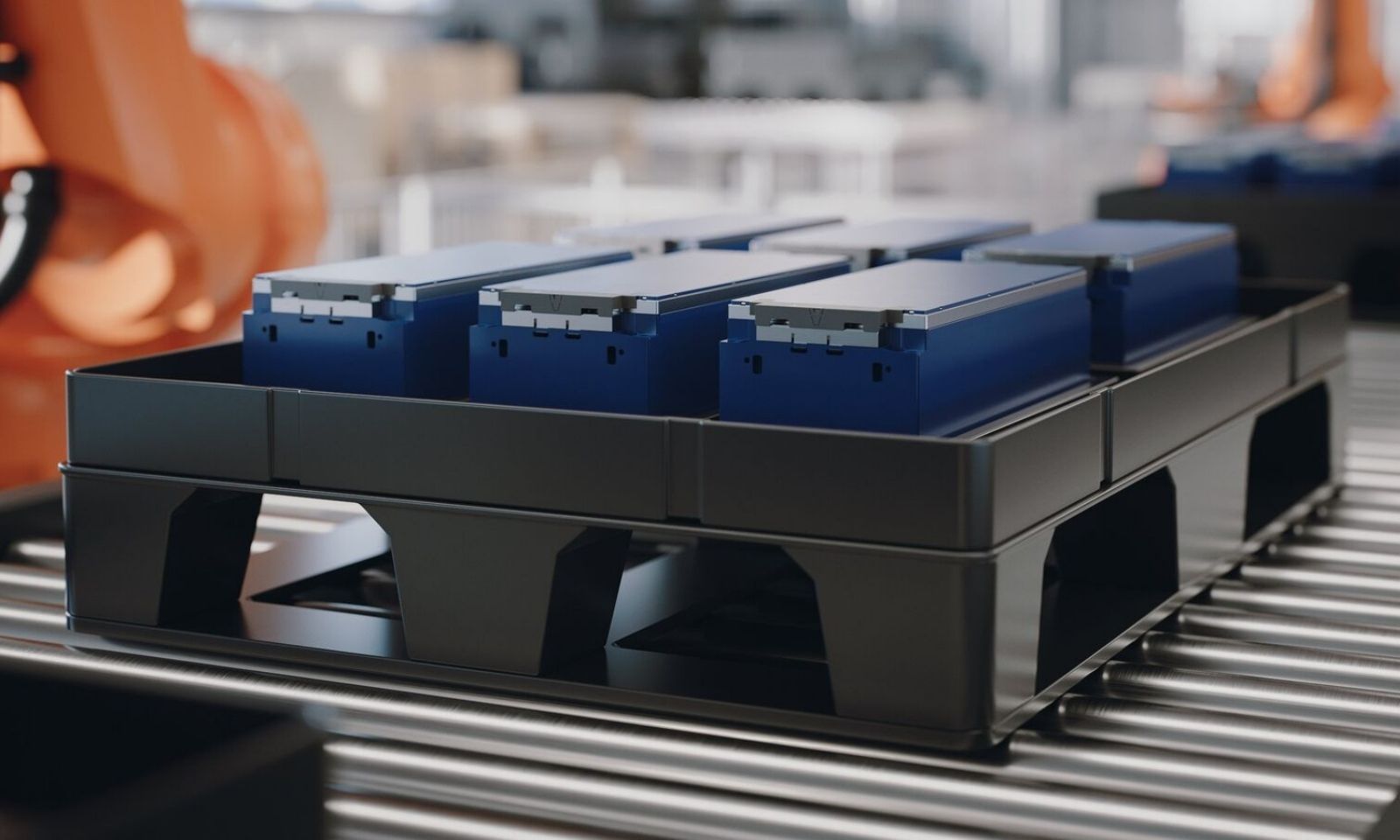
Nefab’s automation trays, made from high-quality materials, are durable and maintain their integrity even with repeated use.
The Shift Toward Engineered Plastic Packaging
As production volumes increased and automation became more common in battery plants, packaging had to do more than just protect parts in transit. The focus shifted to solutions that could hold their shape, last longer in reuse loops and keep performing reliably trip after trip.
That’s why more companies stared moving toward rigid plastic packaging, particularly thermoformed and injection-molded solutions.
Thermoformed plastic trays: a transitional step
Thermoforming is a process where a plastic sheet is heated and formed into a shape, such as a tray. For companies, it is an attractive option as it:
- Holds up better than foam, which supports reuse
- Usually comes with shorter lead times compared to more complex tooling
- Reduces material use through recycled content and recyclability. Often the material can be reground... at the end of life to produce new trays (within the “take-back systems6 ”)
That said, thermoformed trays still come with trade-offs. Compared to injection-molded design, they are typically less precise and offer fewer design options. Depending on the setup, thermoforming can also be more manual and may deliver lower output than high-speed molding processes.
As a result, thermoforming is often a good fit for mid-volume programs, or as a transitional solution during production ramp-up.
Thermoforming (also called vacuum forming) describes the process of heating up a plastic sheet. a plastic sheet is heated until soft, then pulled into shape over a mold using suction. Once it cools, the extra plastic is trimmed off to make the final part.
Injection-Molded Packaging: Built for Scale and Automation
For large-scale lithium-ion battery production, injection-molded plastic packaging has become the go-to option.
Injection molding produces highly precise, durable trays that hold their shape and perform consistently. Those are the key requirements for automation and high-throughput operations where even small variations can slow things down.
From a manufacturer’s perspective, the advantages are clear:
- Tight dimensional tolerances that support automated handling
- High durability across multiple reuse cycles
- More design flexibility, including complex shapes and features
- Easy cleaning, making it well suited for closed-loop logistics7
The biggest drawback is the higher upfront costs. However, when evaluated through a total cost of ownership lens, injection-molded solutions often deliver strong returns in high-volume environments by reducing damage, downtime, and operational variability.
At that point, the decision becomes less about unit cost and more about long-term reliability and efficiency.
Why Packaging Choice Becomes Strategic Decision
“There’s no single “best” packaging solution for every lithium-ion battery shipment, what works depends on where a production is today and how quickly it needs to scale,” said Amaury. “Early-stage programs often prioritize flexibility and low upfront investment, while larger operations tend to focus more on durability, repeatability for automation, and logistics efficiency.”
A good packaging strategy reduces risk upfront, supports smoother operations day-to-day, and avoids costly redesigns in the future.
We save resources in supply chains for a better tomorrow.
Want to learn more?
GET IN TOUCH
Contact us to learn more about our smart and sustainable solutions.
LEARN MORE
Solutions for the LiB and E-mobility & Automotive Industries
Sustainable Protection for Your Equipment
Plastic packaging trays for transport & automated handling
Nefab provides plastic trays designed for sustainability, efficiency, and protection. Our custom tray solutions ensure safe transport, handling, and storage of sensitive components.
GreenCalc
Nefab’s own certified calculator measures and quantifies financial and environmental savings in our solutions
Global Supply & Local Services
With over 250 engineers across more than 30 locations, working together in a global network, you can count on us for your next packaging project.