The shift toward regionalized telecom supply chains is deliberate. According to PwC, about 60% of COOs are considering local or reshored production and sourcing to strengthen resilience and reduce risk1. It reflects a push for faster response times and less dependence on single-region manufacturing, while also helping reduce transport-related emissions by limiting long-haul freight. At the same time, it adds telecom supply chain complexity that must be managed carefully.
But as production and sourcing spread across regions, coordination becomes harder. Equipment now arrives from multiple suppliers, in different packaging and on different timelines, before reaching centralized telecom supply hubs. At the same time, telecom networks are becoming more distributed and more dependent on suppliers. This makes telecom logistics harder to keep in sync.
The Risk at Telecom Supply Hubs
Telecom supply hubs are designed to support deployment by bringing together equipment from multiple suppliers and preparing it for delivery to installation sites. But in reality, things rarely arrive perfectly aligned.
When inbound shipments arrive late, damaged, or even slightly out of sequence, hubs end up waiting for the missing parts needed to complete each site delivery. One missing component can hold back an entire site deployment.
This is where challenges start to build. All components must be kitted at the warehouse before they can be sent to the installation site. If one radio unit, bracket, cable set, or any accessory is delayed, the site kit remains incomplete. That leads to extra storage, re-kitting, additional handling, and missed dispatch windows.
Typical challenges at the hub include:
• fragmented inbound deliveries from multiple suppliers
• shipments arriving out of sequence
• incomplete site kits delaying dispatch
• additional handling, storage, and re-kitting
And the impact doesn’t stop at the warehouse: installation teams are left waiting, site activation is delayed, and revenue is pushed back.
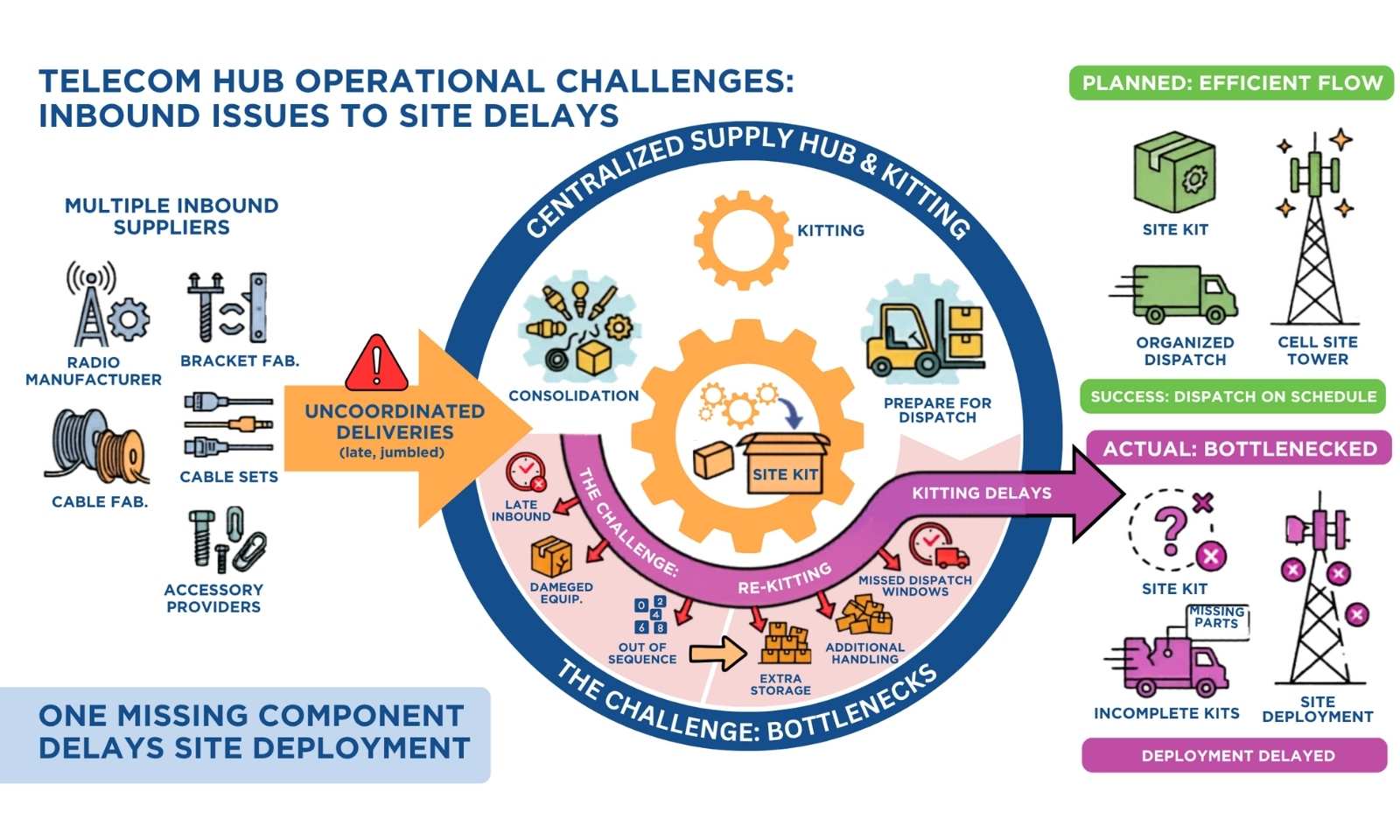
Fragmented inbound logistics in telecom supply chains. Multiple suppliers, inconsistent deliveries, and out-of-sync shipments create delays at supply hubs and slow down 5G deployment. Source: Generated by (Gemini 2026), modified by Nefab, based on internal data.
Why Site Readiness Matters More in 5G Deployment
These challenges become even more critical in 5G rollout, where deployment speed is a competitive advantage. With global 5G subscriptions forecast to reach around 6.4 billion by 2031, the scale of deployment is accelerating fast2.
Compared with previous generations, 5G requires more sites, more equipment, and faster deployment across a wide range of environments, from dense urban areas to remote terrain.
That makes site readiness critical. Equipment must arrive complete, protected, and ready to be installed. That is why smart telecom packaging solutions3, combined with better visibility4 and site-ready kitting, are becoming increasingly important. Approaches like “one site, one box” help ensure that all components arrive together, reducing delays at the hub and simplifying work at the installation site.
What the “One site, One Box” Approach Looks Like in Practice
A telecom supplier operating a centralized supply hub for nationwide site deliveries faced similar challenges. Radio units arrived from the manufacturer, while accessories and installation materials came separately from multiple third-party providers, often at different times and in inconsistent packaging formats.
That led to fragmented deliveries, incomplete kits, repeated handling, and time-consuming re-kitting before dispatch.
The objective was clear: improve visibility and control of site kits, eliminate time consuming on-site kitting, reduce freight and handling costs, and ensure reliable, timely installations.
To address this, Nefab implemented packaging solution that consolidated shipments from the manufacturer and multiple third-party providers into a single, standardized, stackable “one site, one box” solution5. All components required for a site were packed together and shipped as one unit, ready for deployment. A stackable design with standardized box sizes and reinforced pallets ensured protection during transport and efficient container loading.
The impact was immediate. Fewer handling steps, improved visibility and control over site kits, and no need for repacking at the hub or on site. Container utilization increased from 48 to 90 units, reducing freight costs while supporting faster, more predictable installations.
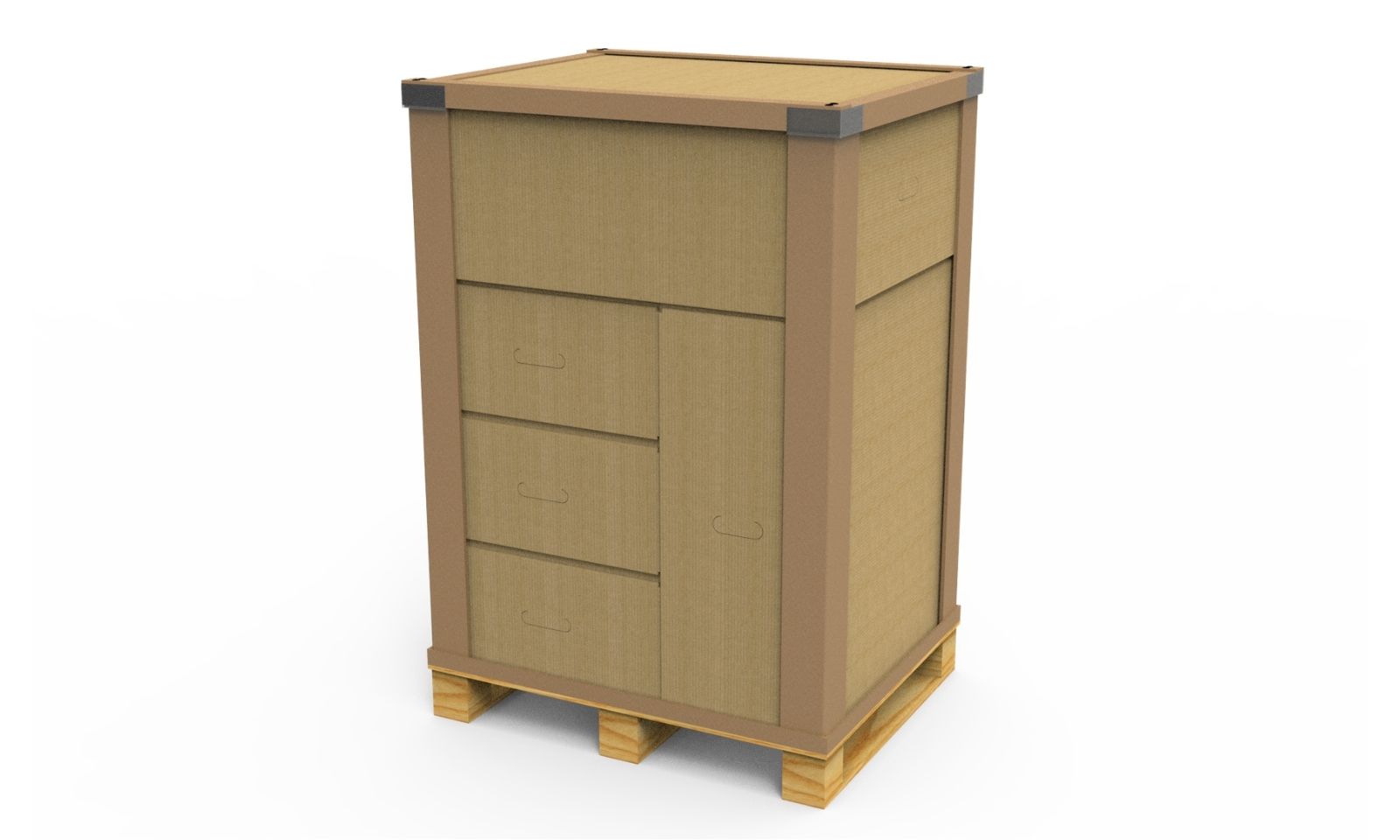
As telecom supply chains evolve, keeping inbound flows aligned becomes key to smoother, faster site delivery.
Even small improvements in how equipment is consolidated, protected, and delivered can make a real difference in reducing delays and keeping deployments on track.
We save resources in supply chains for a better tomorrow.Want to learn more?
GET IN TOUCH
Contact us to learn more about our smart and sustainable solutions.
LEARN MORE
Solutions for the Telecoms Industry
Sustainable Protection for Your Equipment
GreenCalc
Nefab’s own certified calculator measures and quantifies financial and environmental savings in our solutions
Global Supply & Local Services
With over 250 engineers across more than 30 locations, working together in a global network, you can count on us for your next packaging project.